Back to blogs


Why Rediscovering Past Candidates is Your Team’s Biggest Missed Opportunity
Here’s what happens every Monday morning on recruiting teams across the country: someone opens a new req, fires up LinkedIn, and starts scrolling through profiles of people who’ve never heard of the company. Meanwhile, somewhere in the depths of the ATS, there’s a candidate who interviewed last year and only lost out because the hiring manager had a nephew who “needed a job.”
Recruiters spend hours sourcing new candidates while thousands of pre-vetted, company-familiar prospects sit untouched in databases costing five figures a year to maintain. This fixation on "new" costs money, and it slows teams down.
Below, we break down why past candidates deserve a second look and how to build talent rediscovery into an efficient workflow.
Why past candidates are worth revisiting
Your ATS is full of people who came close. They made it through screening, impressed someone in the interview loop, but didn't get hired. These candidates often fall into a few categories, and all of them are worth a second conversation:
The silver medalist
This candidate made it to the final round, and the decision was tight enough that the hiring manager probably agonized over it. If you'd posted the same role six months later with a slightly different hiring manager or a slightly different team dynamic, they might have been the pick.
These people already proved they can do the work and showed they could fit into the culture. The only thing standing between them and an offer was someone else who happened to edge them out by the thinnest of margins.
The timing casualty
Maybe this candidate was in the middle of relocating and couldn't start for another three months when you needed someone in six weeks. Maybe they had a family situation that required their attention or were finishing a big project they couldn't abandon without burning bridges.
Life gets in the way of career transitions all the time, but circumstances change and people become available. The candidate who couldn't move cities last winter might be settled and ready now.
The square peg
This candidate was genuinely strong, but the role wasn't quite right for what they were looking for or what you needed. It’s possible they were too senior for an IC position where you needed someone comfortable taking direction, or not quite senior enough for a leadership track where you needed someone who'd already managed teams.
Maybe this person specialized in growth marketing when you needed someone focused on brand, or they were a backend engineer when the role required full-stack experience. If you have a different opening now that matches their skills and career goals, they could be a perfect fit.
Most recruiting strategies treat past applicants like expired produce. Once the role closes, the candidates might as well not exist. But these are people who wanted to work with you, and that interest doesn't vanish when one role doesn't work out.
The strategic benefits of talent rediscovery
When recruiting teams prioritize rediscovery, the payoff shows up fast. Past candidates move through the hiring process differently than cold prospects, and the difference compounds at every stage.
You start with a warm lead
Candidates who interviewed with your company don’t need to be sold on who you are or what you do. When you reach out about a new opportunity, you're continuing a conversation that already started, which means response rates are higher, and outreach won’t require the same level of effort to break through.
The vetting is already done
You know these people can interview well because they've already done it. You know their resume is accurate because someone on your team has verified it. This enables you to move faster because you're building on existing knowledge rather than gathering basic information all over again.
Time to fill drops significantly
The average time to hire is around 36 days, but rediscovered candidates often close in half that time. They're not sitting in your pipeline for weeks while you figure out if they're qualified. The entire cycle compresses because you're working with someone who's already partway through the funnel.
Candidate experience improves
Following up with someone months after their first interview sends a clear message that your company doesn't ghost people when a role doesn't work out. It shows you keep track of good talent and that you're genuinely interested in finding the right fit. Even if the second conversation doesn't result in a hire, you've reinforced that your company treats people with respect.
Costs stay low
External sourcing comes with overhead including job board fees, LinkedIn Recruiter licenses, agency commissions, and advertising spend. Rediscovery costs almost nothing by comparison because you're working with data you already own.
How to build talent rediscovery into your recruiting workflow
The teams that do talent rediscovery well treat past candidates like a well-maintained talent pool, not a graveyard they occasionally visit when they're desperate. Here’s how to build rediscovery into your workflow:
1. Start with intake meetings.
Before anyone posts a new job or opens LinkedIn, sit down with the hiring manager.
Ask if you’ve interviewed people with these qualifications before.
Walk through recent roles that required similar skills.
Pull up candidates who made it to later rounds but didn't get offers.
This takes ten minutes and often surfaces two or three people worth reaching out to immediately.
2. Set up alerts for role repeats.
If you're filling software engineering positions every quarter or hiring account executives twice a year, flag when similar roles open up. Some ATS platforms let you set notifications for certain job titles or departments. If yours doesn't, create a simple tracker that reminds you to check past applicant pools before sourcing externally.
3. Create candidate pools by skill and role type.
Instead of letting candidates disappear after a role closes, organize them into ongoing pools grouped by discipline or level. Tag them with context that will help you find them later. For example, "Strong backend engineer, wasn't ready for senior level but would be great IC" is more useful than "qualified" six months down the line.
4. Get hiring managers on board.
Talent rediscovery only works if hiring managers trust that past candidates are worth their time. Show them that these candidates have already been vetted and will move faster than cold prospects.
When a hiring manager sees a rediscovered candidate accept an offer in three weeks instead of two months, they'll start asking you to check past applicants first.
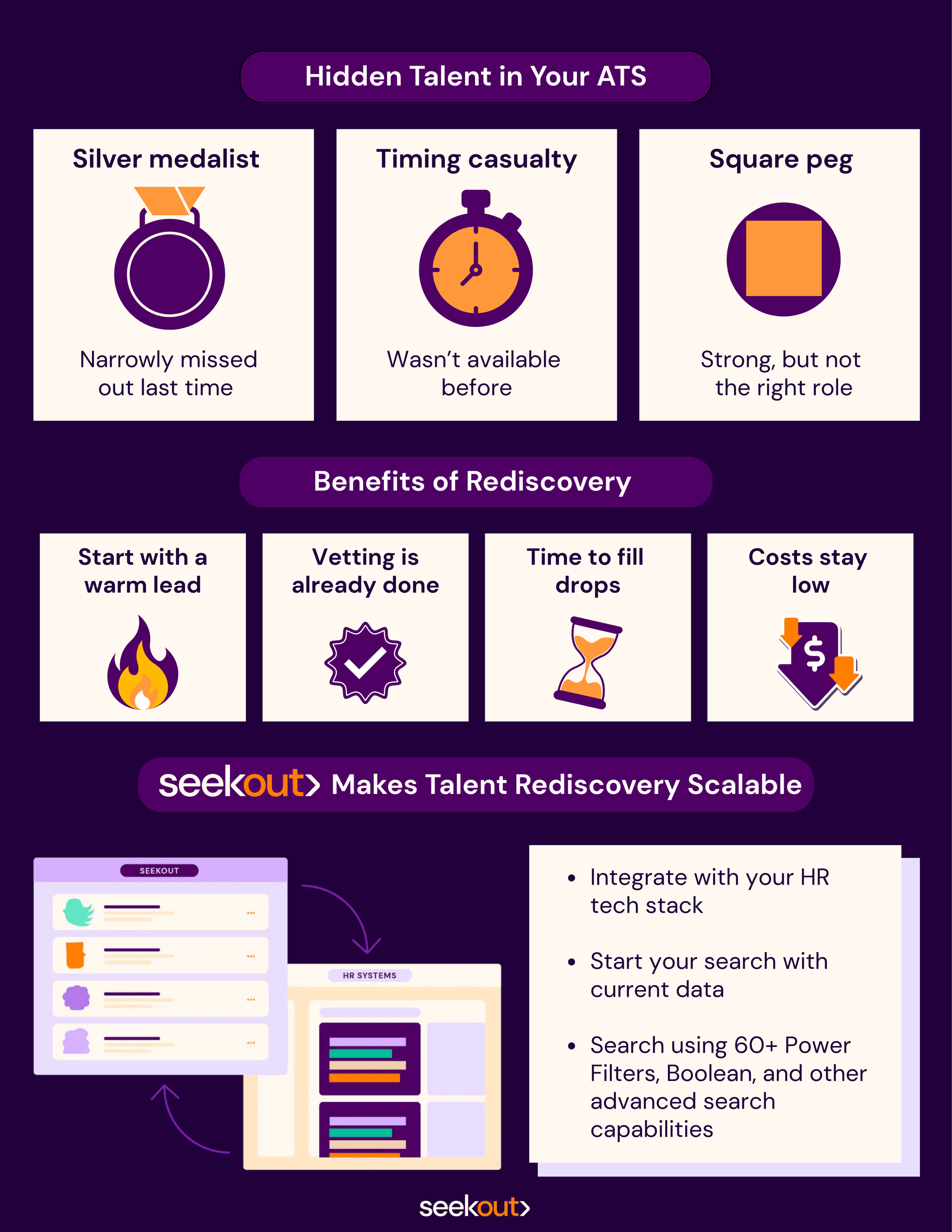
How SeekOut makes candidate rediscovery scalable
You can tag candidates and create pools and set reminders, but that only gets you so far when you're managing hundreds of roles and thousands of past applicants. At a certain scale, you need tools that do the heavy lifting.
SeekOut Recruit integrates with your ATS and enriches outdated candidate profiles with current data, which means you're not just searching through stale resumes from six months ago.
The platform mirrors your ATS data daily and adds:
Social links and updated LinkedIn profiles
Current work history and recent promotions
New education and certifications
If someone interviewed for a mid-level role last year and has since been promoted to senior, that updated information appears in their profile without you having to manually check LinkedIn.
Search that works
SeekOut Recruit also offers powerful search features, with 60+ Power Filters, Boolean search, and advanced AI search capabilities that let you search by current title, experience, and company.
You can filter by:
Rejection reason to find silver medalist candidates
Last contact date to identify people your team hasn't reached out to in months
Interview stage to see who made it furthest in the process
Recruiter or owner to coordinate across your team
Companies making successful hires find 44% of them already in their ATS. The difference is having a system that makes them findable and surfaces them at the right time rather than leaving them buried under thousands of other profiles.
Don't let good talent slip away
Talent rediscovery works because it builds on investments you've already made. You've spent time and money attracting past candidates, evaluating them, and moving them through your process. Walking away from them because one role didn't work out means starting from scratch every time.
If your current tools make rediscovery feel impossible, that's a tools problem, not a strategy problem. SeekOut’s technology helps teams resurface past candidates quickly, so every new req doesn’t have to start from scratch. To learn more, request a demo today.
Frequently asked questions about talent rediscovery
1. What is candidate rediscovery?
Candidate rediscovery is the practice of revisiting and re-engaging people already in your ATS or talent database (past applicants, interviewees, and finalists) when a new role opens, instead of starting from cold sourcing.
2. Why should recruiters revisit past candidates before sourcing new ones?
Because you already invested time in sourcing, screening, and interviewing them. Rediscovery typically lowers sourcing costs, speeds up hiring, and improves pipeline quality since you’re starting with candidates who already cleared key hurdles.
3. Which past candidates are best to rediscover first?
Start with:
Silver medalists (finalists who narrowly missed the offer)
Timing casualties (qualified, but unavailable when you needed them)
Role-mismatch candidates (strong, but not right for that specific job)
These groups are usually fastest to re-engage and evaluate.
4. How does candidate rediscovery reduce time-to-fill?
Rediscovered candidates move faster because you have prior interview feedback, verified qualifications, and less “who are we” ramp-up. That reduces time spent on early funnel steps and shortens the overall hiring cycle.
5. What should recruiters say when reaching out to a past candidate?
Reference the prior interview/application, share why this role is a better match now (team, scope, level, timing), and offer a clear next step like a short call. Keep it respectful and specific, not generic.
6. How do you build talent rediscovery into your recruiting workflow?
Bake it into intake and ops:
Review past candidates before posting the role
Set a trigger for repeat roles to check prior pipelines
Create skill-based pools and consistent tags (stage, reason, level readiness)
Show hiring managers faster hires from rediscovery to build buy-in
7. What ATS fields and tags make talent rediscovery easier later?
The most useful are:
Interview stage reached
Rejection reason
Last contact date
Role/skill tags
Level readiness notes (ex: “strong IC, not ready for manager yet”)
Owner/recruiter for coordination
8. How does SeekOut Recruit support talent rediscovery at scale?
SeekOut Recruit integrates with your ATS to make past candidates easier to find and act on. It can refresh profiles with current data (like updated work history and links) and supports deeper search and filtering so rediscovery doesn’t rely on manual digging or stale resumes.
See us in action
Learn how SeekOut unifies people data to help organizations reach their talent goals
Request a demo