Back to blogs


The first few days back at work are often greeted by a familiar realization. While many of us took some time off, the work never stopped. Inboxes piled up, requisitions stayed open, and your hiring plans are now fighting for the same scarce time and attention as everything else. January should be a fresh start, but in recruiting, it rarely is.
For those of us responsible for talent acquisition, the pressure starts to build up around this time of year. Pipelines that cooled off or went dormant over the holidays never fire back up as seamlessly as you hope. Hiring managers want to hit the gas pedal even though work got paused halfway through the year.
It’s at this point that many teams get derailed. The knee-jerk reaction is to clear out all the noise and start over by simply reopening roles and rebuilding pipelines from scratch. But that strategy comes with its own set of costs. It’s time-consuming, damages candidate trust, and makes it even harder to build back momentum. Restarting your hiring pipeline after the holiday lull works best when you know what changed during the break and can return with intention.
What Happens to Open Requisitions Over the Holidays?
When hiring slows over the holidays, open reqs don’t go away. They tend to sit in place, and while the pause feels temporary, it changes the state of the work more than most teams expect. By the time January arrives, restarting momentum can feel heavier than anticipated.
A few things can happen during extended breaks:
Pipelines grow quieter as candidates take longer to respond and conversations lose their natural cadence.
Priorities shift in subtle ways, with budgets, timelines, or expectations changing even if the role itself looks the same on paper.
Ownership becomes less clear as coverage changes, handoffs happen, and context gets lost along the way.
None of this happens all at once, which is why it’s easy to miss. But when everyone returns, recruiters often find themselves working with reqs that feel familiar yet no longer fully reflect reality. It’s harder to know where things left off and how much pressure to apply to move things forward.
The Common January Mistake: Starting From Zero
When open reqs feel disorganized or stalled, starting over can seem like the simplest solution. Clearing the pipeline and rebuilding from scratch creates a sense of control at the beginning of a new year when everything feels overdue for a reset.
But that clean slate is often misleading. Starting from zero means giving up more than teams realize:
Candidate context gets lost, along with the nuance of past conversations.
Outreach that was already underway has to be restarted.
Momentum that existed before the break has to be rebuilt from the ground up.
This approach also puts added pressure on recruiters to move quickly, even when speed isn’t the real issue. More often, what’s missing is clarity around the role or the capacity to move candidates through the pipeline.
A more effective approach is to slow down just enough to assess what’s still working, preserve the progress you’ve already made, and restart with intention instead of urgency.
A Better Way to Reopen Reqs
Rather than starting from scratch, January is a good moment to pause and understand where each req stalled and why. A short, thoughtful reset often does more to move hiring forward than a full rebuild ever could.
Start by looking at the pipeline you already have.
Some conversations went quiet simply because of timing, while others still have momentum beneath the surface. Reviewing where candidates dropped off and which stages slowed down helps you see which reqs need a light nudge and which ones need more attention.
Re-ground the role before moving forward.
Priorities, timelines, and expectations often shift during the break, even when the job title stays the same. Reconnecting with the hiring manager to confirm what’s still true and what’s changed keeps sourcing and screening from being guided by outdated assumptions.
Match the response to the real bottleneck.
Some reqs slowed because sourcing took longer than expected and need more efficient search. Others stalled because volume outpaced capacity and require extra support to move candidates through. More complex roles may need deeper focus, not speed.
Use this quick checklist to reopen roles without resetting your entire hiring process. It keeps things practical and helps maintain pipeline continuity:
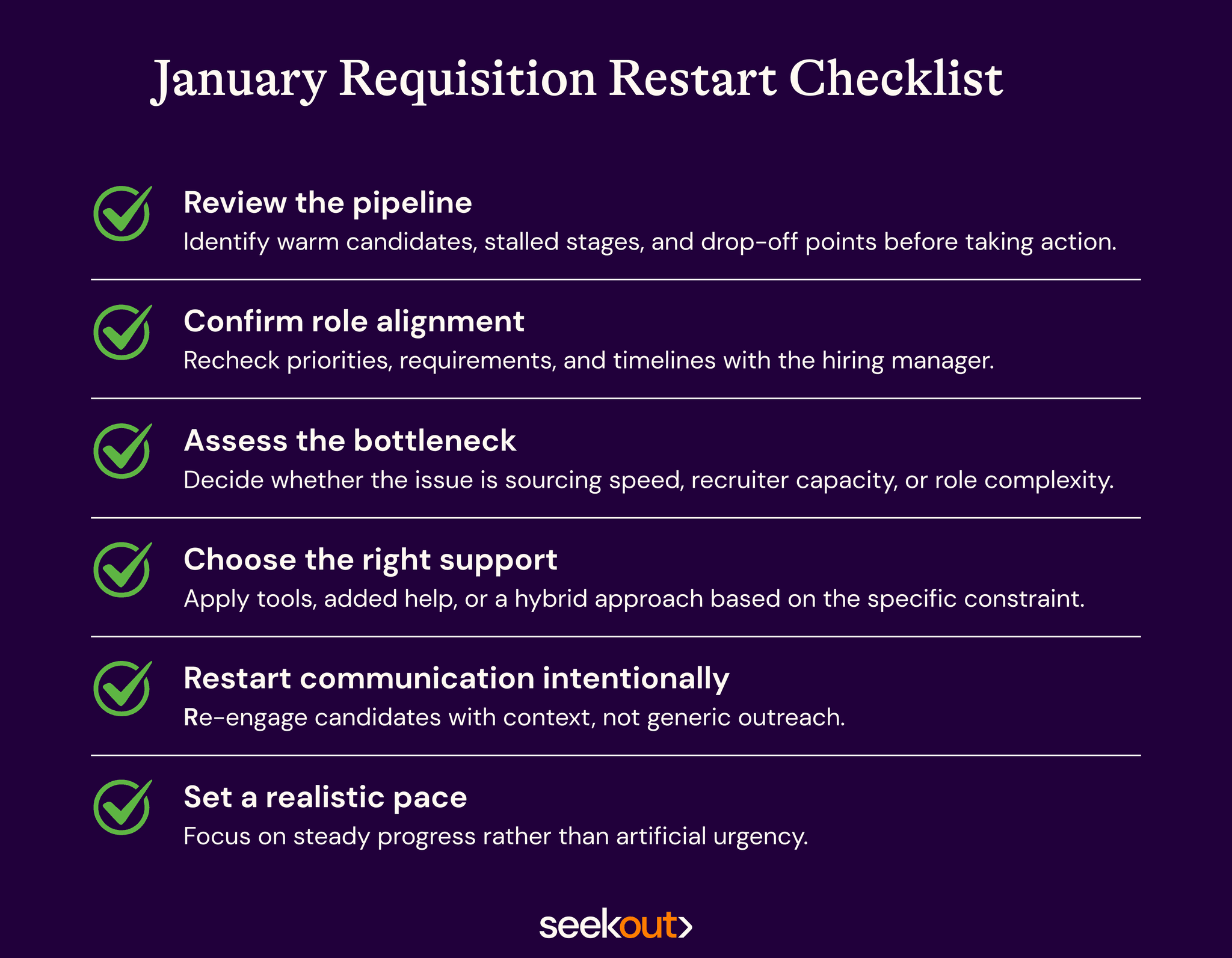
Why Flexibility Matters More Than a Perfect Plan
Open reqs don’t all need the same level of attention, and treating them that way creates unnecessary friction. Flexibility allows teams to allocate effort more intentionally. Instead of applying the same process to every role, support can shift based on where progress is slowing or where momentum already exists and just needs reinforcement.
When flexibility is built into how hiring operates, it stops being a reactive adjustment and becomes part of a cadence that moves teams forward long past January 1.
Where SeekOut Fits into a January Restart
Once it’s clear why a req stalled, the question becomes how to support it going forward. January often brings that decision into sharper focus, because the gaps in speed, capacity, or focus are harder to ignore.
When the challenge is rebuilding momentum:
Some reqs slow down because sourcing and search take longer than they should. In these cases, the work isn’t blocked by volume or complexity, but by how efficiently recruiters can identify and move qualified candidates through the pipeline.
SeekOut Recruit’s AI recruiting platform supports these restarts by helping teams regain speed without changing how they already work.
When the challenge is capacity:
Other reqs stall because there simply aren’t enough hours in the day. Pipelines grow, priorities stack up, and candidates sit in limbo while recruiters juggle competing demands.
SeekOut Spot’s agentic AI recruiting service adds hands-on support to keep work moving when volume spikes or internal capacity is stretched.
When the work requires both:
In many January scenarios, teams are managing a mix of needs at once. Certain roles require faster search, while others need added support to stay on track.
Using Recruit’s AI recruiting platform alongside Spot’s agentic AI recruiting service allows teams to shift support based on what each req actually demands, rather than forcing everything into a single approach.
Instead of asking every role to fit the same model, this flexibility allows teams to restart hiring in a way that reflects the work in front of them and adjust as priorities evolve.
Build a Hiring Rhythm that Lasts
Reopening reqs after the holiday break is often the first real test of your recruiting strategy for the year. How you handle January sets the tone for everything that follows.
Teams that take a measured approach by reviewing pipeline health, realigning roles, and applying the right level of support tend to move through hiring cycles with less friction. Instead of repeatedly restarting, they build a hiring pipeline that can absorb shifts and spikes without losing momentum.
With clarity and flexibility, January can be the point where your recruiting process settles into a rhythm that works for the long term. If you’re thinking through how to support your hiring team this year, we’re happy to talk through what that could look like. Schedule a meeting with us to explore options that fit your needs.
Book now
Request a meetingFAQs Recruiters Ask in January
How do you restart a hiring pipeline after the holidays?
Start by reviewing what already exists. Audit pipeline stages, reconnect with hiring managers to confirm priorities, and re-engage candidates with context. The goal is to reactivate momentum, not rebuild from scratch.
Should you reopen job requisitions in January or start new ones?
In most cases, reopening existing requisitions is more efficient. It preserves candidate context, saves time, and reduces duplicate work. Starting over should be the exception, not the default.
Why does hiring feel harder in January?
Hiring resumes midstream. Pipelines slowed, priorities shifted, and ownership changed during the break. January pressure comes from restarting with less clarity, not from a lack of effort.
What’s the best recruiting strategy for January hiring?
Focus on flexibility. Match the solution to the bottleneck for each role, whether that’s faster sourcing, added capacity, or deeper support for complex reqs.
How can recruiters prevent pipelines from stalling after time off?
Clear handoffs, documented role changes, and intentional re-engagement with candidates help maintain pipeline health during and after pauses.
See us in action
Learn how SeekOut unifies people data to help organizations reach their talent goals
Request a demo